


Walk into any serious kitchen in Ponte Vedra, Sawgrass, or the newer builds in Nocatee and there’s a decent chance of finding a Miele dishwasher behind the custom cabinetry panel. These are the quietest, longest-lasting dishwashers money can buy — Miele literally tests them for 20 years of use before putting them on the market. So when yours starts throwing an F14 or F79 code on the display, or won’t drain through what should be a bulletproof pump, or stops dispensing from the AutoDos reservoir, the right response isn’t the same as calling the guy down the street who works on Whirlpools.
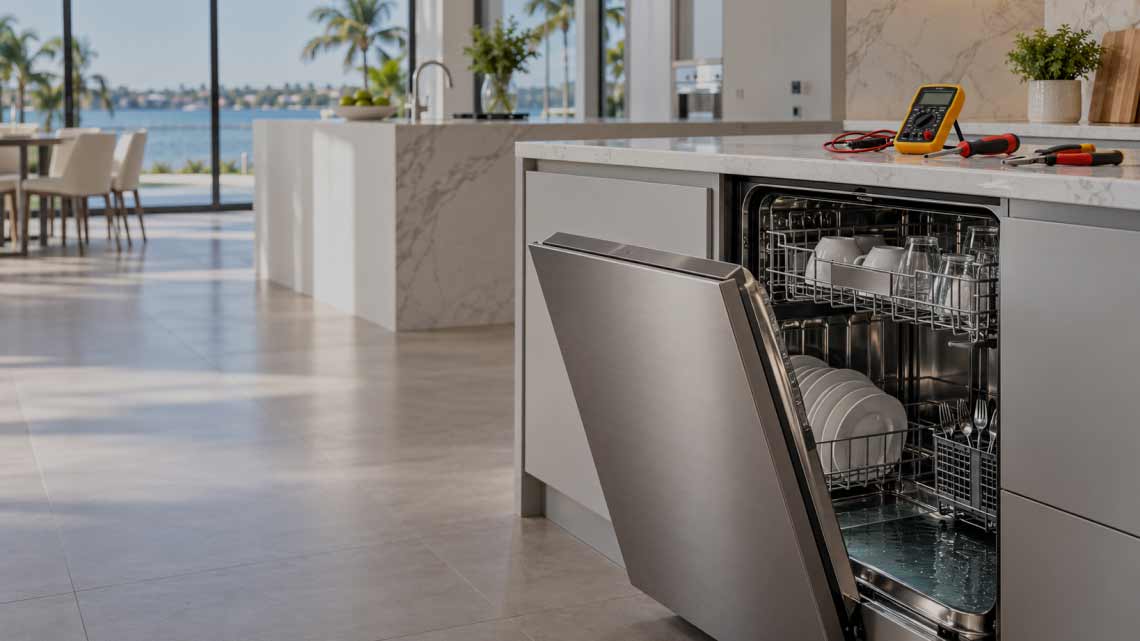
Finding genuine appliance repair Jacksonville FL service for Miele isn’t like finding regular dishwasher repair. Below walks through what makes Miele different, where these German-built units actually fail, what the fault codes mean, what repairs really cost, and how to tell whether the technician at your door actually understands what he’s looking at. Spoiler: most generic appliance guys don’t.
What Makes Miele Different
Three things set Miele apart from everything else on the dishwasher market, and all three affect how repair work gets done.
- Built in Germany for 20-year lifespans. This isn’t marketing fluff. Miele actually tests units at their factory in Gütersloh for the equivalent of 7,500 cycles — roughly 20 years of typical home use. The materials are heavier, the tolerances are tighter, and the parts cost accordingly. A Miele circulation pump looks nothing like a Whirlpool pump internally.
- Heat pump drying instead of heated element. Most dishwashers either use a heating element at the bottom to dry (Whirlpool, GE) or rely on residual heat and condensation (Bosch, newer models). Miele’s premium units use an actual heat pump — the same technology in modern HVAC — to dry dishes efficiently. When it fails, dishes come out wet. When a tech doesn’t know Miele uses heat pump drying, they start looking at heating elements that don’t exist.
- AutoDos and PowerDisk system. Mid-to-high end Miele dishwashers (G 7000 series especially) use PowerDisk cartridges instead of liquid or tablet detergent. The AutoDos module dispenses the right amount automatically based on load. When this system fails — stuck motor, blocked dispenser, drained PowerDisk not recognized — you need a tech who knows the AutoDos subsystem exists. Most don’t.
The Fault Codes That Actually Matter
Miele dishwashers communicate problems through F-codes on the display. The ones showing up in Jacksonville homes most often:
- F14 — Water heating circuit issue. The most searched Miele fault code and one of the most common failures past year 5-7. Usually means the heating element or its control board relay has failed. On heat pump units, could be the heat pump compressor itself. Not DIY — needs component-level diagnosis.
- F11, F12, F13 — Water intake and heating related faults. Could be inlet valve, flow meter, or heating circuit. Each code narrows down what’s broken, which is why reading the exact code matters.
- F18 — Drainage issue. Pump itself, drain hose blockage, or occasionally the drain pump control circuit.
- F24 — Heating element issue (older units with traditional heating).
- F70 — Water level sensor issue, often triggered by the AquaStop safety system.
- F79 — Heat pump compressor failure. Specific to units with the heat pump drying system. Expensive repair but still cheaper than replacing a $2,000+ Miele.
- F84 — Rotary spray arm sensor or motor fault.
Walking in without knowing what the specific code means and starting to replace parts guess-and-check is how people end up with $1,200 in replaced parts when the actual issue was a $45 sensor.
Schedule your appliance repair today!
Common Miele Failures We See in Jacksonville
Over the years working on Miele dishwashers across Jacksonville, the failure patterns settle into a predictable pattern.
- Water inlet valve failures. Jacksonville water is hard. Really hard in some areas — 180-220 ppm hardness. Miele dishwashers have built-in water softeners (that’s what the salt indicator is for), but the inlet valve itself still deals with raw water and eventually scales up. Replacement valve is a specific Miele OEM part, not a universal appliance valve. Trying to substitute kills the warranty and often doesn’t fit properly.
- AutoDos module stops dispensing. Common on G 7000 series around year 3-5. PowerDisk gets stuck, the dispensing motor fails, or the module needs cleaning. Not something a generic appliance tech knows to diagnose — they’ll tell you to use regular detergent instead, defeating the whole point of why you bought a $2,500 dishwasher.
- Heat pump compressor on drying units. On G 7000 Series units with heat pump drying, the heat pump itself can fail around year 7-10. Shows up as F79 code. Dishes come out noticeably wet. This is a real repair — replacement compressor runs $400-600 for parts, plus labor. Still worth doing on a $2,500 appliance.
- Door hinge springs wearing out. Miele’s door has a signature controlled-close feel — doesn’t slam, holds at intermediate positions. When the hinge springs weaken, the door starts falling open or won’t stay at the half-open position. Replacement parts are specific to the Miele model generation.
- Water softener regeneration issues. The built-in softener uses salt (there’s actually a salt reservoir — Miele dishwashers run on salt the way old water softeners did). When the regeneration cycle fails, water hardness isn’t being reduced, scale accumulates faster everywhere, and the salt indicator light stays on even after refilling.
- Rotary spray arm bearings. Signature Miele feature — a third spray arm (middle-rack) that uses a specific bearing design. Fails around year 10-12. Replacement is straightforward if you have the exact Miele part.
- Custom door panel issues. Many Miele units in Jacksonville homes have custom cabinetry panels covering the door. Loose panels, misaligned mounting hardware, or door tension issues from heavy custom panels — all specific to how the unit was installed. Repair means working with the actual panel without damaging the custom finish.
About That Water Softener Salt Thing
Something that catches most Jacksonville Miele owners by surprise: the dishwasher uses actual salt (dishwasher salt specifically, available online or at Miele dealers). This is because Miele’s built-in water softener works by ion exchange — same as a whole-house water softener.
In hard-water areas like Jacksonville, you’ll need to refill the salt reservoir maybe every 2-3 months. Miss this and you’ll see:
- White film on glasses
- Scale buildup on heating element
- Salt indicator light staying on
- Water inlet valve dying faster than it should
Not a repair issue per se — but something that causes repairs if ignored.
Series-Specific Notes
Different Miele series have different common problems:
- Classic Plus Series (older, mostly discontinued): Water heating issues (F14), door seal wear, inlet valve failures. Parts getting harder to source on units older than 15 years.
- G 4000 Series (mid-tier residential): Water inlet valve, drain pump, door hinge spring issues. Still fully supported by Miele parts.
- G 5000 Series (modern premium): AutoDos module issues (if equipped), heat pump concerns on drying units, standard pump and valve wear.
- G 7000 Series (current flagship): AutoDos reliability has improved, but heat pump units still see F79 codes around year 7-10. Smart diagnostics through Miele@home app are useful but introduce new failure categories around Wi-Fi connectivity.
- Futura Dimension / Diamond (older US-market lines): Treat similar to Classic Plus for parts and service — mature platform, parts available but aging stock.
- ProfiLine (commercial): Different beast entirely — commercial cycles, specialized dispensing. Needs tech specifically trained on Miele professional equipment.
Real Cost Numbers
Miele repairs cost more than mainstream brands. These are honest ranges you can expect in Jacksonville:
- Diagnostic service call (comes out, reads codes, tells you what’s wrong): from $100, typically credited toward repair if you proceed
- Water inlet valve replacement: $300-500
- Drain pump replacement: $350-550
- Heating element replacement (traditional dry units): $400-650
- Heat pump compressor replacement (F79 fix): $900-1,400
- AutoDos module repair/replacement: $350-700
- Door hinge spring replacement: $250-400
- Rotary spray arm bearing: $200-350
- Main control board replacement: $700-1,200
- Door gasket replacement: $250-400
Yes, these ranges are higher than Whirlpool or GE repair pricing. OEM parts cost more, labor takes longer because Miele’s engineering is more complex, and the specialized diagnostic knowledge required means fewer qualified techs. On a $2,000-4,000 dishwasher that’s going to last 20 years, a $600 repair that keeps it running another 8-10 years is still the right financial move. A high-rated appliance repair company will give you a flat quote after diagnosis before any work starts.
How to Tell the Tech Actually Knows Miele
Miele officially has a Factory-Trained Service Partner network, but qualification varies.
Signs you have the right person:
- Reads the exact F-code and knows what it means before quoting anything.
- Mentions whether your unit has heat pump drying — Miele has multiple drying systems across model years, and the tech should know which one you have.
- Asks about salt refills and water softener regeneration — a generic appliance tech won’t know Miele uses salt.
- Comes with Miele-specific parts or can source them without a two-week wait.
- Works around the custom cabinetry panel without damaging it.
A real Jacksonville appliance repair service for Miele also has an honest conversation about whether a repair makes sense on your specific unit. On an 18-year-old Classic Plus with multiple failures, replacement might be the smarter path. On a 5-year-old G 7000 with just an AutoDos problem, repair is a no-brainer.
Jacksonville-Specific Factors
- Hard water everywhere. Jacksonville’s groundwater hardness averages 180-220 ppm, which falls into the «hard» category. Your Miele’s internal softener handles it, but only if the salt reservoir stays filled. Half the «my Miele isn’t cleaning right» calls trace back to empty salt and depleted ion exchange capacity.
- Humidity year-round. Especially summer. High ambient humidity makes condensation drying less effective — one more reason heat pump drying on premium Miele is worth the extra cost in Florida specifically.
- Hurricane surge damage. Lightning strikes and power surges during hurricane season fry control boards. Miele boards are expensive. Whole-house surge protection is cheap insurance.
- Custom cabinetry integration. Most Jacksonville Miele installations are built-in with panel-ready doors. Removing a Miele for service means working around custom finishes — not something you want someone inexperienced handling.
Name: Appliance Repair Jax
Adress: 164 Johns Glen Dr, Jacksonville, FL 32259
Phone: (904) 200-4110
Website: https://appliancerepairjax.com/
Conclusion
Miele dishwashers represent a serious investment in long-term kitchen reliability. Whether yours needs a simple inlet valve replacement, a complex heat pump compressor swap, or just the right diagnostic read on a fault code before anyone touches parts, the specialist you call matters more than for mainstream brands. Appliance Repair Jax handles Miele service across Jacksonville — including Ponte Vedra, Sawgrass, Nocatee, Saint Augustine, and the Beaches — with the diagnostic knowledge, parts network, and custom-installation experience these premium German-engineered units require.
