


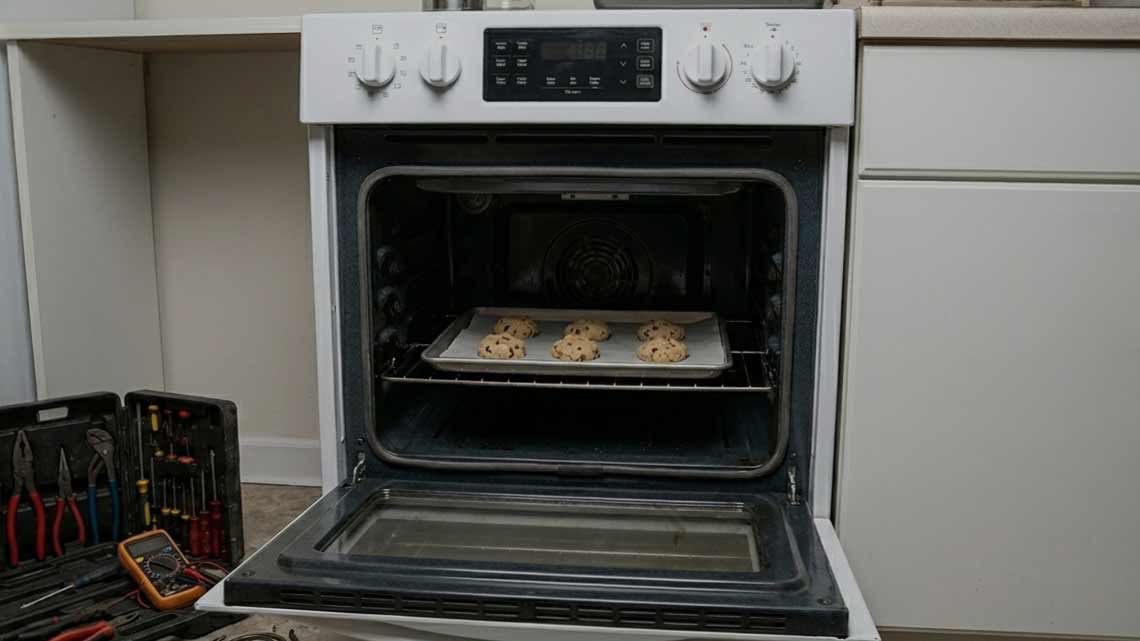
Few things kill dinner plans faster than an oven that just… won’t get hot. You preheat, you wait, you check — and twenty minutes later it’s still barely lukewarm inside. Maybe the display says 350°F but the racks tell a different story. Maybe nothing happens at all. Either way, dinner isn’t getting made tonight, and now you’re wondering what went wrong.
Here’s the good news: an oven not heating up is one of the more diagnosable appliance problems out there. There are really only a handful of things that cause it, and a few you can check yourself before calling for home appliance repair Jacksonville FL. Below are the eight most common culprits, what each one looks like, and which ones you can tackle without a tech.
1. A Burnt-Out Bake Element (Electric Ovens)
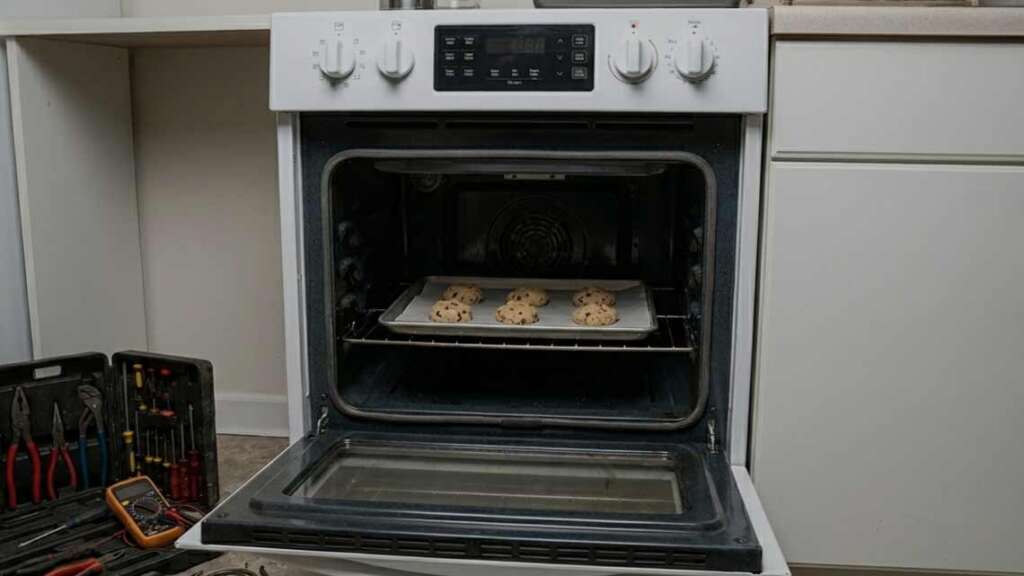
This is the number one cause we see for an electric oven not heating up. The bake element is that curved metal coil along the bottom of the oven. When it works, it glows bright orange. When it burns out, it doesn’t glow at all — or you’ll spot a visible break, blister, or scorched spot in the coil.
DIAGNOSIS:
Turn the oven on and watch the element for a minute. No glow, no heat. Bad element.
The good part? It’s one of the more affordable oven repairs and the swap is straightforward.
Schedule your appliance repair today!
2. A Faulty Igniter (Gas Ovens)
For gas ovens, this is the single most common reason for no heat — by a wide margin. The igniter does two jobs: it gets hot enough to light the gas, and it tells the gas valve to open. When it weakens with age, it can’t draw enough current to trip the valve, so gas never flows and the oven never heats.
It glows weakly but never actually lights.
If your gas oven is not heating but the burners on top work fine, a dying igniter is almost always the answer.
3. A Broken Oven Temperature Sensor
Modern ovens have a temperature sensor — a thin metal probe sticking into the oven cavity — that tells the control board how hot it is. When the sensor fails, it feeds the board garbage readings. Sometimes that means no heat. Sometimes the oven heats wildly wrong: an oven not heating to the correct temperature, running 100 degrees off, or shutting down mid-bake. If food keeps coming out raw or burnt despite the right setting, suspect the sensor.
4. A Tripped Thermal Fuse
Just like a dryer, your oven has a thermal fuse — a one-time safety device that cuts power if the oven overheats.
The most common trigger? Running the self-clean cycle, which gets brutally hot. That’s why we get so many “oven not heating after self cleaning” calls. Once the fuse blows, it doesn’t reset — it has to be replaced.
If your oven went totally dead after a self-clean, this is suspect number one.
5. A Bad Control Board
The control board is the brain of the oven — it takes your settings and tells the heating components what to do. When it fails (power surges and age are the usual reasons), it might stop sending the “heat now” signal entirely.
Symptoms vary:
- the display might work fine while the oven stays cold
- the panel might glitch, freeze, or show partial functions.
Control board issues are trickier to diagnose and usually a job for a tech with the right tools.
6. A Faulty Bake or Broil Relay
Inside the control board are relays — little switches that route power to the bake and broil elements.
AN INTERESTING CLUE:
If your oven broils fine but won’t bake (or vice versa), you’re probably looking at a bad relay rather than a dead element.
Each side runs through its own relay. This is exactly the pattern behind a lot of “gas oven not heating but broiler works” situations.
7. Power Supply or Wiring Problems
Electric ovens run on a 240V circuit that uses two legs of power.
Here’s the sneaky part: if one leg fails (a half-tripped breaker, a loose connection, a burnt wire), the oven might still light up and run the clock — the control board only needs 120V — but the heating elements won’t work because they need the full 240V. So you get an oven that looks alive but won’t heat.
PRO TIP:
Reset the breaker fully off-then-on. If the display works but there’s zero heat, this is worth investigating.
8. Wrong Settings or a Locked Control Panel
Don’t roll your eyes — this trips up more people than you’d believe. Ovens have delay-start timers, Sabbath mode, demo mode, and child locks, any of which can leave you with a cold oven.
Demo mode is especially sneaky: it lets the panel light up and respond but disables all heating (it’s meant for showroom floors).
PRO TIP:
Check your manual, cancel everything, and try a plain bake at 350 before assuming a part has failed.
Quick Checks Before You Call Anyone
Run through these in order — they take five minutes and rule out the easy stuff:
- Reset the breaker. All the way off, then back on. Knocks out the half-power issue.
- Watch the bake element glow (electric). No glow at all = burnt element.
- Listen for the igniter (gas). Glows but never lights = weak igniter.
- Test broil vs. bake. One works, one doesn’t? Points to a relay or element, not the whole oven.
- Cancel all modes. Kill any timers, locks, demo, or Sabbath settings, then try a basic bake.
What You Can Fix vs. What Needs a Tech
A bake element swap is genuinely DIY-friendly — two screws, two wires, fifteen minutes, cheap part. Settings and breaker resets cost nothing. Beyond that, things get involved fast. Igniters, temperature sensors, thermal fuses, relays, and control boards all require disassembly and usually a multimeter to confirm the diagnosis before you spend money on parts.
And with gas ovens specifically, we’d strongly suggest calling a high-rated appliance repair company rather than going it alone. Gas connections aren’t something to improvise on. A trained tech can pinpoint a weak igniter versus a bad gas valve in minutes — and do it safely.
How a Service Visit Works
When our Jacksonville appliance repair techs come out for a no-heat oven, we work the whole chain methodically — element or igniter, temperature sensor, thermal fuse, relays, control board, and the power supply.
We test components rather than guessing, give you a price before doing the work, and carry common parts on the truck. Whirlpool, GE, KitchenAid, Frigidaire, Samsung, Maytag, Kenmore, Bosch, Thermador — all fair game.
Most no-heat repairs wrap up in a single visit.
A Few Words on Prevention
The biggest preventable cause? The self-clean cycle. It runs the oven so hot that it routinely fries thermal fuses and stresses control boards. If you can clean your oven by hand instead, your appliance will thank you with a longer life. Beyond that, don’t slam oven doors, and if you ever notice the oven running hot or cold, get the sensor checked before it cascades into a bigger problem.
Name: Appliance Repair Jax
Adress: 164 Johns Glen Dr, Jacksonville, FL 32259
Phone: (904) 200-4110
Website: https://appliancerepairjax.com/
Conclusion
An oven that won’t heat is frustrating, but it’s rarely a mystery once you know the eight usual suspects. Check the easy stuff first — breaker, settings, element glow — then work toward the trickier components. If you’d rather skip the guessing and get dinner back on track, Appliance Repair Jax handles no-heat oven calls across Jacksonville.
