


Walk into any serious kitchen in Ponte Vedra or Nocatee and there’s a decent chance of finding a Sub-Zero sitting at the center of it. These things cost between $8,000 and $20,000 new, run for 20-25 years with half-decent maintenance, and generally outlive the kitchen they got installed in. So when yours starts acting up — temperature drifting, ice maker giving you half the normal output, that little service light coming on for no obvious reason — the stakes feel different than when a Whirlpool starts throwing fits. You’re not debating “fix or replace” the same way, because the replace side of that equation is $12,000 and a kitchen renovation to swap out the custom panels.
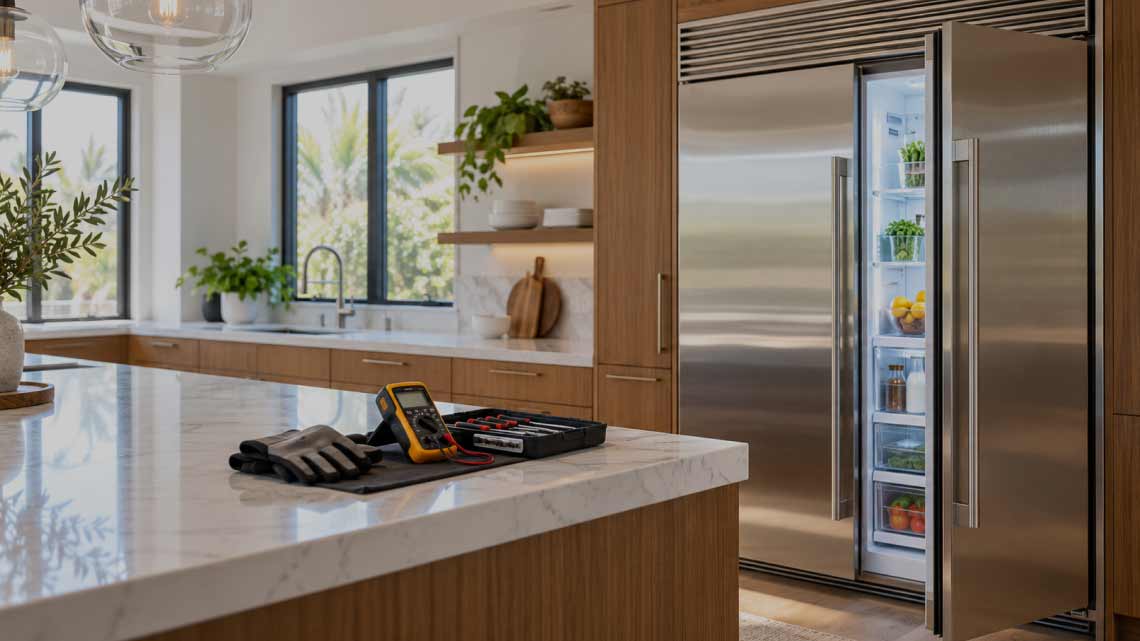
Finding real appliance repair Jacksonville FL service for Sub-Zero isn’t the same as finding somebody who works on standard appliances either. Below is what makes these units different, where they actually fail, what repairs really cost, and how to tell whether the person showing up to your house actually understands what they’re looking at.
Dual Compressor Thing Is Important
Here’s the core difference nobody tells first-time Sub-Zero owners. Pretty much every Sub-Zero built since the mid-1990s runs two separate refrigeration systems — one for the fridge section, one for the freezer. Each has its own compressor. Own evaporator. Own thermostat. Completely independent.
Sounds like a minor engineering choice. It’s not.
What it actually means for you: one side can completely fail while the other side keeps running like nothing happened. The freezer stays rock solid at zero while the fridge drifts up to 48 degrees. Or the opposite — ice is frozen fine, your lettuce is sweating. Standard fridge owners calling a repair guy go “my fridge isn’t cold.” Sub-Zero owners have to actually look at both sections and figure out which half is misbehaving.
For repair work it means two things:
- Diagnosis takes longer because the tech is working through two separate systems.
- And parts aren’t interchangeable between the sides — the evaporator fan motor for the freezer section is a different part number than the one for the fridge section even on the same unit.
Any tech who looks at a Sub-Zero and starts talking about “the compressor” without specifying which one — walk away.
The Service Light Actually Means Something
That little “Service” indicator on the vacuum fluorescent display isn’t decoration. Sub-Zero’s control board tracks a bunch of parameters constantly and lights that up when something’s drifting from spec:
- Could mean the condenser needs cleaning.
- Could mean a sensor’s gone bad.
- Could mean the ice maker module is on its way out.
- Could mean the main board itself is confused.
The point is, there’s a specific code behind it, and reading that code requires putting the board into service mode with a specific button sequence that varies by series. A tech who shows up, sees the service light, and immediately starts quoting a control board replacement without pulling the actual diagnostic data? That’s a guy who doesn’t know Sub-Zero. Could cost you a $900 control board when the real issue was a $40 sensor.
Schedule your appliance repair today!
What Actually Breaks on These Units
Over years of calls on Sub-Zero refrigerators across Jacksonville the failure patterns settle into a predictable list.
- Ice maker goes first on most units. The 648, 650, and newer 7000 series ice makers tend to need service around year 7-10. Could be the module itself, could be the water inlet valve, could be freezer temperature drifting slightly out of spec. Jacksonville water is hard enough that scale buildup on the inlet accelerates failure. Repair usually means swapping the full ice maker module — Sub-Zero doesn’t really do piece-part ice maker repair.
- The condenser gets dusty and causes everything else to fail. This is the single biggest preventable issue. The condenser lives behind the top grille, and over 6-12 months it collects a layer of household dust that cuts airflow. Reduced airflow means the compressor runs hotter, works harder, eventually dies early. Lady called us last year — had a 2008 Sub-Zero that “wasn’t cooling right.” Pulled the grille, the condenser was packed solid with cat hair and dust. Cleaned it out. Fridge dropped back to spec within 24 hours. Zero parts. Just hadn’t been cleaned since installation.
- Evaporator fan motors wear out. One section loses airflow while the other stays normal. Classic Sub-Zero symptom pattern. Fan motor replacement is maybe an hour’s work plus the part, and most Sub-Zero techs stock these on the truck for common series.
- Compressors on older units. 500 and 600 series units that have never been serviced may need compressor replacement around year 18-25. It’s a real repair — not a $200 job. But a new compressor keeps the unit running another 10+ years, which still beats $12,000 for a new installation.
- Water line leaks behind built-in units. The water line routing through built-in installations has specific weak points. Pinhole leaks in the line itself. Failed solenoid valves at the back. Sometimes the fitting at the house water supply. Not always obvious until you pull the unit forward.
- Door gaskets get crispy. Rubber hardens over the years. The door starts not quite sealing. The compressor runs more to maintain temp. The energy bill goes up. Gaskets are a known replacement item, usually around year 10-12 on heavy-use units.
Series Breakdown
Different Sub-Zero series fail differently:
- 500 Series (mostly 1990s to early 2000s): These are now in the 25+ year range. Many are still running fine, but the ones that don’t usually need either a compressor or a control board. Control boards for discontinued 500s have gotten harder to source — real conversation about replace-vs-repair starts entering the picture.
- 600 Series (2000s to around 2015): Peak era for Sub-Zero built-ins. Ice maker modules and evaporator fan motors lead the call list. Compressors are still mostly solid.
- 648 and 650 (overlap with 600 era): Same mechanical platform as 600, same failure patterns. Ice maker issues are very common around year 7-10.
- 7000 Series (post-2017, “Classic” line): Newer electronics with Wi-Fi connectivity. Smart integration adds some new failure categories but mechanical reliability stays strong.
- Pro 48 and Pro 36: Heavy-duty professional-grade. Longer intervals between service calls, but when something breaks, parts and labor run higher than regular Sub-Zero.
- Wine Storage (424, 427, 430 and others): Specialized temperature zone management. Needs a tech who knows wine units specifically — not just general Sub-Zero service.
Real Cost Numbers
Sub-Zero owners always want to know pricing upfront, and the ranges are what they are:
- Diagnostic call (comes to your house, pulls codes, tells you what’s wrong): from $100, usually credited toward the repair if you move forward
- Condenser cleaning plus seasonal checkup: $200-300
- Ice maker module replacement: $400-700
- Evaporator fan motor replacement: $350-550
- Water line or solenoid work: $150-350
- Door gasket replacement: $300-500
- Compressor replacement: $1,200-2,500 depending on series and which side
- Control board replacement: $800-1,500
Yeah, these are higher than mainstream brands. OEM parts cost more, labor takes longer, specialized diagnostic knowledge means fewer techs can do the work. On an appliance worth $10,000+, a $700 repair that keeps it running another 5-10 years is still great math. A high-rated appliance repair company will give you a flat quote after diagnosis — before any work starts — so there’s no surprise at the end.
When to Call Right Away vs When It Can Wait
Not every Sub-Zero issue is urgent:
- Fresh food above 42°F for more than a few hours (food safety starts to matter)
- Freezer above 10°F
- Water pooling under the unit or dripping into cabinetry
- Burning smell or weird mechanical noises
- Ice maker producing less than normal or not at all
- Service light on the display
- Temperature running warmer or cooler than setpoint consistently
- Door not quite sealing
- Condenser cleaning (the one maintenance item that prevents the most expensive failures)
- Water filter change
- Gasket check
How to Tell the Tech Actually Knows Sub-Zero
Sub-Zero and parent brand Wolf-Sub-Zero run a factory-certified technician network, but certification is one thing — actual experience is another. What matters:
- Pulls diagnostic codes with the proper button sequence instead of guessing from symptoms.
- Carries common Sub-Zero parts on the truck (ice maker modules, fan motors) because they expect to need them.
- Knows how to pull the top grille and work the condenser without wrecking custom cabinetry.
- Mentions dual compressor specifically when describing diagnosis — someone who talks about “the compressor” like there’s just one hasn’t worked on these units much.
A real Jacksonville appliance repair service for Sub-Zero also has a frank conversation about whether a particular repair makes sense on a particular unit. On a 25-year-old 500 series with three previous repairs, honest math might say “put the money toward a new one.” On a 10-year-old 648 with just an ice maker problem, repair is a no-brainer. Techs who always push repair regardless of unit condition — or who always push replacement without even trying — are both doing you wrong.
Name: Appliance Repair Jax
Adress: 164 Johns Glen Dr, Jacksonville, FL 32259
Phone: (904) 200-4110
Website: https://appliancerepairjax.com/
Conclusion
Sub-Zero refrigerators are serious appliances that reward serious service. Whether yours needs an ice maker module, a condenser cleaning, or something deeper, the right tech matters more than it does on mainstream brands. Appliance Repair Jax covers Sub-Zero service across Jacksonville — Ponte Vedra, Nocatee, St. Augustine, the Beaches — with the diagnostic knowledge, parts access, and built-in installation experience these units require.
