


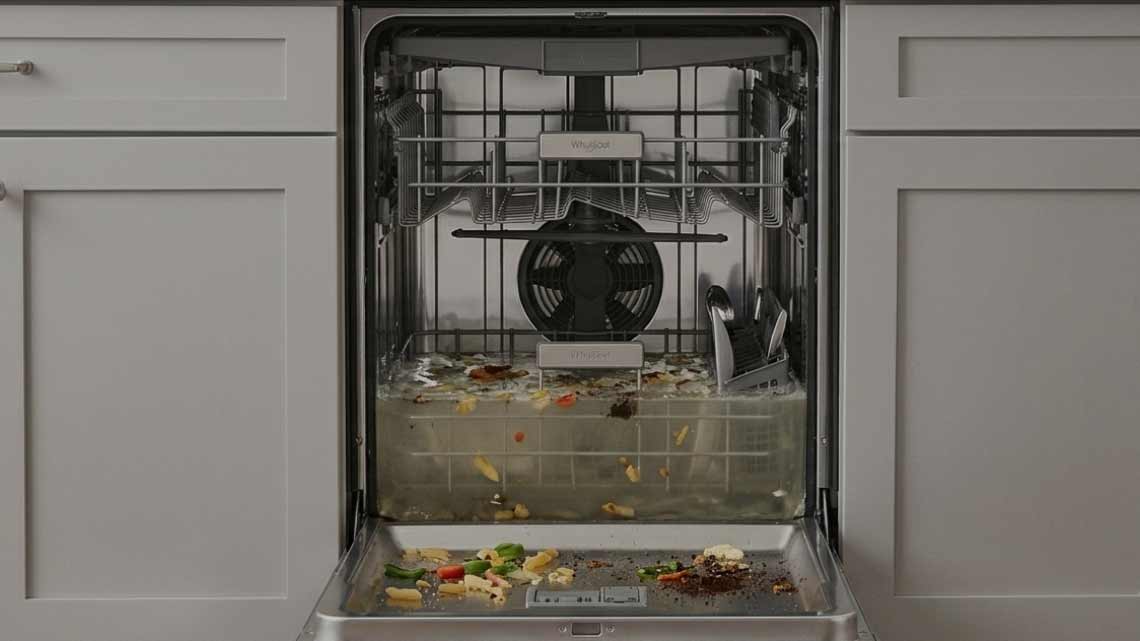
Open the dishwasher, expect clean dishes, find an inch of dirty water at the bottom. Sometimes with bits of food floating around. Sometimes clear-ish but still there. Either way — dishes aren’t done and now something’s wrong. This one lands in our service queue almost daily. Probably the single most common dishwasher call we handle across the year.
Real talk though: more than half of these calls we run end up being stuff the homeowner could’ve fixed themselves in fifteen minutes. Clogged filter. Kinked hose. Garbage disposal knockout still in place from install day. No repair needed. The other half are actual mechanical failures — pump gave out, check valve stuck, board misbehaving. If you’d rather skip the trial and error and just have someone look at it, appliance repair Jacksonville FL techs handle these on same-day service most weeks. Otherwise, work through the seven below in order — easiest wins are at the top.
Schedule your appliance repair today!
1. Filter Packed Solid with Old Food
If you haven’t cleaned your dishwasher filter, ever, and you’re calling us — 30-40% chance this is the whole problem.
Every dishwasher built in roughly the last decade has a filter at the bottom of the tub. Cylindrical, usually, sometimes flat. Twists off. Its job is to catch food scraps before they reach the drain pump. Manuals say clean it every two months. Almost nobody does. Two years later, that filter is compacted with grease, dried tomato skins, coffee grounds, and half a corn kernel from Thanksgiving 2022. Water can’t move through it.
- Pull the bottom rack out.
- Look at the base of the tub for a twist-off filter.
- Turn it counterclockwise. If it feels stuck, wiggle it — old grease can basically glue it in place.
- Take it to the sink.
- Rinse under hot water. If it’s really loaded, hit it with an old toothbrush.
- Twist it back in.
- Run an empty cycle.
Bosch, Miele, KitchenAid, and newer Whirlpool/GE models all use user-serviceable filters. Older units sometimes have hard-plumbed filters that don’t come out — different story if that’s your setup.
2. Drain Hose Is Kinked or Full of Gunk
Second-most-common cause. Two subvariants worth separating.
- Kinked hose. Open the cabinet under your sink. Look at where the dishwasher’s drain line comes up from below and connects to your sink drain or garbage disposal. Modern installs loop the hose up high (called a «high loop») to prevent siphoning. If someone shoved something into that cabinet — a big pot, cleaning supplies, whatever — the hose got pinched. Straightens out in ten seconds. Free fix.
- Clogged hose. Grease and small food particles build up inside the hose over years. Sometimes forms a partial plug that lets a little water through but not enough for a full cycle.
- Diagnostic: disconnect the hose at both ends, run water through it from a faucet, see if it flows freely. If it doesn’t, either fish through it with a straightened coat hanger, or just replace it. Hoses are cheap. Prepare for greasy water everywhere while you do this — bucket underneath, towels within reach.
3. Garbage Disposal Wasn’t Set Up Right
If your dishwasher drains through a garbage disposal (very common setup), the connection between them is a specific failure point.
1. The one that catches new-disposal installs: the knockout plug was never removed. Every disposal ships with a plastic disc blocking the dishwasher inlet. It has to be knocked out during installation. Guy who installed the disposal — plumber, handyman, DIY homeowner, whoever — sometimes forgets. Then the dishwasher runs, tries to pump water into the disposal, and the water has literally nowhere to go. If your disposal is new and your dishwasher stopped draining right after — this is your problem.
Access underneath, use a hammer and screwdriver to punch the knockout out. Takes two minutes.
2. The other one: disposal itself has issues. Backed up, food stuck around the impeller, motor slow.
Run the disposal on its own with the tap running. If it grinds normally and clears, disposal’s fine. If it’s laboring or humming — that’s a disposal problem cascading into a dishwasher symptom. Fix the disposal first.
4. Air Gap Blockage
Some sinks have a small chrome cylinder poking up next to the faucet. That’s an air gap — common in Florida, plumbing code depending on your municipality. It prevents dirty drain water from siphoning back into your dishwasher.
They also clog. Food particles get trapped inside. When they do, drainage stops or backs up out of the top of the air gap onto the counter (fun day).
Twist the chrome cap off. Underneath there’s a plastic cap. Unscrew that. Look inside for gunk. Pull it out with pliers or a stiff wire. Reassemble. Done.
Skip this section if you don’t have an air gap visible on your sink.
5. Drain Pump Died
Now we’re past DIY. Pump is what physically forces water out of the dishwasher during the drain cycle. When it fails, water sits.
Three ways pumps die. Something hard got past the filter and jammed the impeller — chunk of glass, fruit pit, small bone, a piece of a broken dish. Motor bearings wore out from years of running. Or the motor’s electrical windings shorted out.
Symptom is usually specific: during the drain portion of the cycle, you’ll hear humming or clicking but no water actually leaves. Sometimes no sound at all, which usually means dead motor rather than jammed impeller.
Jammed impellers can occasionally be cleared without replacing the whole pump — pull the dishwasher out, access the pump housing from underneath, find the obstruction. Actual dead motor means new pump. Pump replacements are readily available for common brands (Whirlpool, GE, Frigidaire, KitchenAid, Bosch, Samsung, LG, Kenmore), pricier for premium (Miele, Thermador, high-end Bosch). A professional appliance repair company with a multimeter can tell you within a few minutes whether it’s a jam or a dead motor — you don’t want to buy a $150 pump for what turns out to be a $2 kernel of popcorn stuck in the impeller.
6. Check Valve Stuck
The check valve sits in the drain path. Its job: let water flow out during the drain cycle, prevent it from flowing back in afterward. When it fails, one of two things.
- Stuck closed → water can’t drain forward → water sits in the tub.
- Stuck open → dirty drain water siphons back into the dishwasher after the cycle → you open the door to find nasty gray water that wasn’t there when the cycle ended.
Both feel like «not draining» to the homeowner but the underlying failure is different. Check valve is often integrated with the drain pump housing on newer units, so replacement can mean replacing more than just the valve itself. Tech job.
7. Control Board or Timer Is Failing
Least common of the seven, but real. If the control board never sends the «drain now» signal to the pump at the right point in the cycle, the pump never runs. Water sits. Intermittent symptom is typical — drains fine some cycles, not others.
Multimeter test at the pump connector during the drain portion tells you fast: voltage present means the board is trying and the pump is dead. No voltage means the board is the culprit.
Board replacement is the highest-cost repair in this whole list. Sometimes worth doing on a newer dishwasher, sometimes not on a 12-year-old unit where you’re better off buying new. Tech will run that math with you.
How the Service Call Goes
When our Jacksonville appliance repair team gets a «not draining» call, we work down the list in exactly that order. Filter, hose, disposal, air gap, pump, check valve, board. Why in that order? Frequency. Most calls get solved in the first fifteen minutes because it turned out to be one of the first three. If it’s not, we’ve narrowed it fast and can move to the actual repair. Brands we cover: Bosch, KitchenAid, Whirlpool, GE, Frigidaire, Samsung, LG, Kenmore, Maytag, Miele, Thermador, Amana, Jenn-Air, Fisher & Paykel.
Name: Appliance Repair Jax
Adress: 164 Johns Glen Dr, Jacksonville, FL 32259
Phone: (904) 200-4110
Website: https://appliancerepairjax.com/
Conclusion
Most «not draining» calls resolve with a filter cleaning or a drain hose fix — homeowner jobs that take a quarter hour. When it’s actually a pump, check valve, or control board, that’s when a tech is needed. Appliance Repair Jax covers dishwasher drainage repair across Jacksonville, every major brand, same-day service most days when you catch us before noon.
