


Standard scenario: you unload the dishwasher, and there’s the detergent tablet sitting exactly where you put it — dry, whole, or partially dissolved into a chalky lump inside the dispenser slot. The rest of the dishes look like they ran through with plain water. Which they basically did.
Small annoyance the first time. Real problem when it happens every load. If you’re dealing with it, you’re not alone. Below is what actually causes the dispenser to fail, what to try first before calling anyone, and when it becomes a repair job. If you’d rather skip having someone diagnose the dispenser directly, appliance repair Jax FL technicians handle dispenser calls routinely — the fix is usually straightforward once the specific cause is identified.
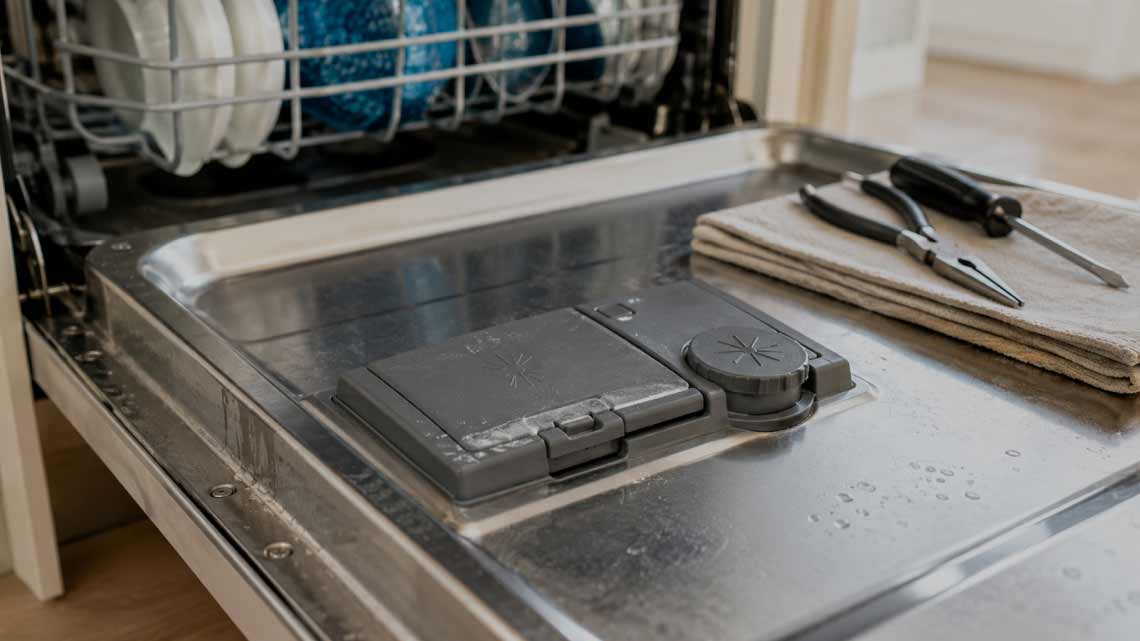
How the Dispenser Actually Works
Quick mechanical background helps here because the fix depends on which part of the system failed.
The detergent dispenser has three main components:
- the compartment where you put the pod or powder,
- a spring-loaded door that keeps it closed until the right moment,
- and a small mechanism (usually a bi-metal actuator or a tiny motor called a wax motor) that releases the door mid-cycle.
The dishwasher’s control board sends a signal at a specific point in the wash cycle — usually about 10-15 minutes in, after the pre-rinse — and the mechanism triggers, spring pops the door open, detergent falls into the water. When any one of those three parts fails, detergent stays trapped. Understanding which part is broken narrows the fix significantly.
What to Check First
Actually the most common reason for a «broken» dispenser is user setup. Check these first:
- Something blocking the door. Top rack dish that’s positioned wrong, oversized platter on the bottom rack, tall glass that’s tilted just enough to lean against the dispenser door — any of these prevents the door from swinging open. Look inside your dishwasher with the racks in place, dishes as you normally load them, and see if there’s anything within a few inches of the dispenser that could block it.
- The dispenser wasn’t fully closed to start. Some dispenser doors need to be pushed firmly until a click. If it wasn’t latched properly, the door might open during pre-rinse and dump detergent way too early. When you check the post-cycle, the door is open but the detergent is already washed away — same appearance as «didn’t dispense properly» but different cause.
- Wrong detergent type. Loose gel detergent poured into the dispenser can be too thick to properly release, or the volume overfills the compartment and the door can’t close. Powder is fine. Tablets are fine. Gel packs are also fine. Straight liquid gel from a squeeze bottle — check your machine’s manual, some don’t handle it well.
1. Detergent Buildup Is Gluing the Door Shut
The most common actual failure. Old, damp detergent residue accumulates around the dispenser rim and inside the door mechanism. Over time it hardens into a crust that literally glues the door shut. The spring is fine, the actuator is fine — the door just can’t move because it’s stuck in dried soap.
The fix takes about ten minutes:
- Get a cup of hot water and a paper towel. Wet the paper towel thoroughly, drape it over the dispenser area, and let it sit for 5 minutes to soften the residue.
- Then take an old toothbrush and scrub the entire dispenser: the door edges, the inside of the compartment, the small hinge points, the little slot where the door tucks in when closed. Get particular about the edges where the door meets the housing — that’s where most of the buildup accumulates.
- Rinse everything with the wet paper towel. Open and close the dispenser door manually a few times to make sure it swings freely. If it moves easily, run an empty test cycle and check whether the detergent releases properly.
This solves probably 40-50% of dispenser-not-opening calls right there, no parts needed.
2. Rinse Aid Interference
Weirdly common issue: if the rinse aid dispenser (usually right next to the detergent dispenser) has been overfilled, rinse aid seeps into the detergent compartment and messes with everything. The result is a slimy, viscous coating on the door mechanism that prevents proper opening.
Look for signs of oily residue or unusual film around the dispenser area.
SOLUTION: If rinse aid overflowed, clean thoroughly with hot water and dish soap (dish soap, not dishwasher detergent — you want to break down the oily rinse aid film). Then only fill the rinse aid to the marked line going forward, not to the brim.
3. Spring or Latch Mechanism Failure
If cleaning didn’t fix it, the mechanical parts are the next place to look.
The dispenser door is held closed by a small spring. When the release mechanism triggers, the spring pushes the door open. Over years of use — usually somewhere past 5-7 years — the spring can weaken, break, or corrode. Similarly, the plastic latch that catches the door can wear down or crack.
Physical test: press the door closed and let go. Should snap shut with clear tension. If it feels loose or doesn’t stay closed on its own, the spring is likely the issue.
Spring replacement is possible on some brands as a separate part (Bosch, some Whirlpool, some KitchenAid). Other brands (Frigidaire, GE, Samsung, LG) usually require replacing the entire dispenser assembly. Either way it’s a repair job — accessing the dispenser mechanism means partially disassembling the door.
4. Wax Motor or Actuator Failure
Deeper failure. Most dishwashers use a wax motor to release the dispenser at the right moment. This is a small device with wax inside that expands when heated by an electrical current, physically pushing a lever that releases the dispenser latch.
When the wax motor fails — either the heating element inside dies, or the mechanism jams — the dispenser never gets the «open» command. Door stays closed, detergent stays trapped. Same visible symptom as a stuck door, different underlying cause.
Testing requires a multimeter and access to the wax motor housing. Definitely a tech job. Parts are inexpensive on most brands (Whirlpool, GE, Frigidaire, Kenmore, KitchenAid), pricier on European ones (Bosch, Miele).
A high-rated appliance repair company can distinguish between a stuck-shut door and a failed wax motor within 15 minutes.
5. Control Board Not Sending The Signal
Rarest of the causes but worth mentioning. If the control board doesn’t send the «release dispenser» signal at the right point in the cycle, everything mechanical stays perfectly functional but nothing triggers.
Symptom: dispenser door works perfectly when you press it manually (tests fine mechanically), spring feels strong, no visible obstruction — but during actual cycles nothing happens.
Diagnosis: tech runs cycle in diagnostic mode and checks voltage at the wax motor connection during the point when it should activate. No voltage = board issue. Voltage present = downstream mechanical or wax motor issue.
Control board repair or replacement is the higher end of dishwasher fixes cost-wise. Sometimes worth it, sometimes replacement makes more sense depending on machine age.
What About Bosch Dispensers Specifically
Bosch gets called out separately because their dispenser design is distinctive — a small compartment door that flips up rather than swinging sideways like most American brands. Bosch dispensers have a specific failure mode: the small plastic cover («detergent dispenser cover») can crack or the pivot points wear out.
If you have a Bosch and the dispenser cover is loose, wobbly, or won’t stay latched, the cover itself is the part to replace. Available separately on most Bosch models. Some homeowners handle this DIY, but you’ll need the exact model number to order the right part.
Miele dispensers are similar in design and have similar failure patterns.
Schedule your appliance repair today!
Tests You Can Run Right Now
Two quick tests that pinpoint the problem before you call anyone.
Test 1 — Manual dispenser test with the door open. Load detergent, close the dispenser, then press the release button or lever (there’s usually one on the outside of the door). Does the door open freely and dump detergent? If yes, the mechanism is fine and the issue is either the wax motor or the control board signal.
Test 2 — Watch through the cycle. Start a wash cycle, then carefully open the door about 12 minutes in (when detergent should have been released). Look inside — is the dispenser door open, closed, partially open? Fully closed at that point in the cycle strongly suggests wax motor or signal issue. Open but detergent still there suggests the door opened but the pod didn’t dissolve properly (different problem — usually related to water temperature or pod age).
How A Service Call Handles Dispenser Problems
When our Jacksonville appliance repair techs get a «dispenser not opening» call, the diagnostic order is predictable. First we check for obstructions and detergent buildup — easy stuff, sometimes the whole fix. Then we test the door mechanism manually. If mechanical parts are fine, we check the wax motor with a multimeter. Last, if wax motor tests good, we verify the control board is sending signals correctly. Usually the whole diagnosis is done inside 20 minutes, and most repairs finish the same visit because dispenser parts are compact and easy to keep stocked. Brands we handle regularly: Bosch, KitchenAid, Whirlpool, GE, Frigidaire, Samsung, LG, Kenmore, Maytag, Miele, Amana, Jenn-Air, Fisher & Paykel, Westinghouse, Beko.
Name: Appliance Repair Jax
Adress: 164 Johns Glen Dr, Jacksonville, FL 32259
Phone: (904) 200-4110
Website: https://appliancerepairjax.com/
Conclusion
Dispenser issues are almost always specific and solvable. Cleaning fixes half of them, mechanical replacement fixes most of the rest, and only rare cases need control board work. When yours doesn’t respond to a thorough cleaning and the door mechanism feels off, that’s when a tech visit becomes worth it. Appliance Repair Jax covers dispenser diagnosis and repair across Jacksonville for every major brand, and the honest recommendation often starts with «clean it first, call us if that doesn’t work.»
More Articles on Dishwasher Repair
- Dishwasher Won’t Start or Turn On: Power & Control Issues
- Dishwasher Stopped Mid-Cycle? Diagnosis & Fixes
- Dishwasher Not Spraying Water: Spray Arm Troubleshooting
- Dishwasher Not Filling with Water? Common Causes
- Dishwasher Not Drying? Why Dishes Come Out Wet
- Dishwasher Leaking Water: Causes & How to Stop It
- Dishwasher Not Cleaning Dishes? Causes & Fixes
- Dishwasher Smells Bad? How to Get Rid of Odors
- Dishwasher Not Draining? 7 Common Causes & How to Fix Them
