


You press the button, close the door, and — nothing. No lights, no hum, no reaction whatsoever. Or maybe the lights come on but pressing Start does absolutely zero. Either way, you’ve got a kitchen full of dirty dishes and an appliance that’s refusing to acknowledge your existence. Not the most dramatic dishwasher problem, but one of the more infuriating ones because there’s no indication of what’s actually wrong. You’re far from alone with this one. The reasons split pretty cleanly into two camps: power delivery problems (electricity isn’t reaching the machine, or isn’t being used properly) and control system problems (electronics are alive but refusing to initiate a cycle).
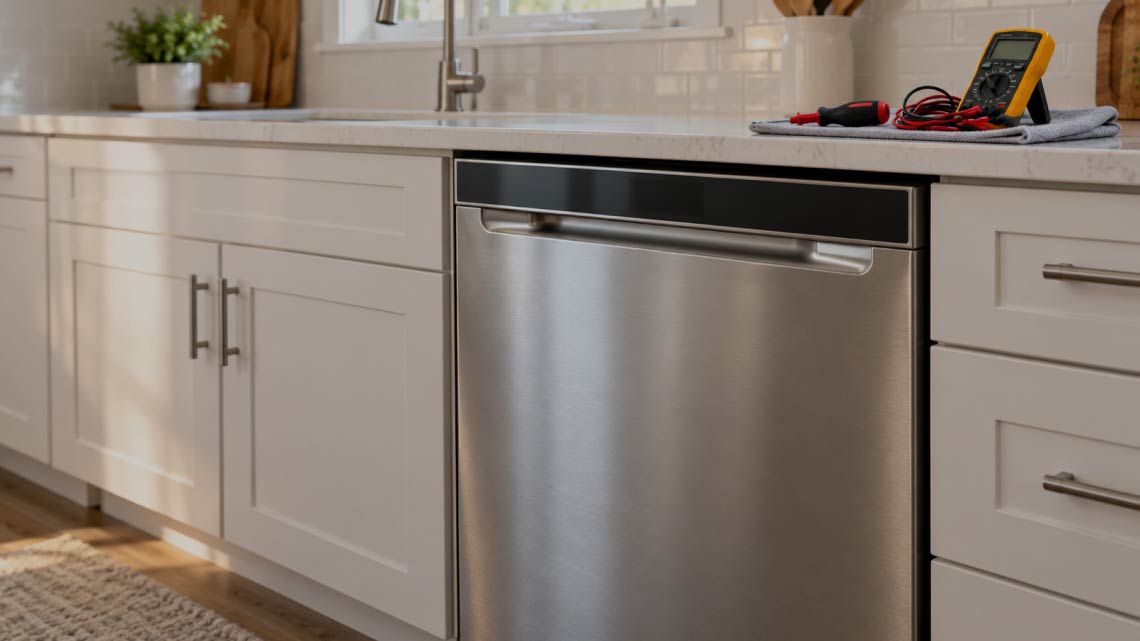
Below works through both camps with the actual diagnostic order a technician would use. If your kitchen’s been out of commission since this morning and you want it sorted by evening, appliance repair Jax FL techs handle no-start calls as one of the fastest diagnostics — typical answer inside 15 minutes on-site.
Figure Out Which Camp You’re In
Thirty seconds of observation saves twenty minutes of random troubleshooting.
WHAT TO DO: Press any button on the control panel. Watch the display and any indicator lights.
- Lights, display, or any response at all = control system issue. Electricity is reaching the machine. Something in the control circuitry is preventing cycle start.
- Nothing happens, the display stays dark, no sound = power delivery issue. The machine isn’t getting electricity, or isn’t getting enough of it to even wake up the control board.
These two categories go different directions. Confirming which one you’re facing is the first real diagnostic step.
No Power, No Lights, Nothing
Dead machine means tracing the electricity path backward from the dishwasher.
- Check the breaker first. Standard first move. Kitchen electrical panel, find the circuit labeled «dishwasher» or «kitchen.» Look at whether it’s sitting cleanly in the ON position, or whether it’s slightly off-center (tripped). A tripped breaker needs to go fully OFF, then fully ON. Not partial. If it immediately trips again after you reset it, that’s a sign of an electrical fault inside the dishwasher — motor shorting, water contact with wiring, control board failure — and continued attempts to reset it won’t help.
- GFCI outlet reset. Some dishwasher installations use a GFCI outlet (common in newer kitchens, mandatory in some code jurisdictions). If the GFCI tripped, you’ll see the test/reset button sticking out. Press reset firmly until it clicks in. The machine should wake up.
- Check for a shut-off switch. Not all installations have one, but some kitchens have a dedicated wall switch near the sink that controls dishwasher power. People accidentally flip these during cleaning, cabinet work, or just general kitchen activity. Verify any such switch is in the ON position.
- Verify the plug or hardwire connection. If the machine plugs into an outlet, pull it slightly out from under the counter (power off at breaker first) and verify the plug is fully seated. For hardwired installations, that’s electrician territory — don’t start pulling apart junction boxes yourself.
- Thermal fuse blown. Internal to the machine. The thermal fuse sits in the control panel area and blows if the machine overheats during a cycle. Blown fuse = total power loss from the control board’s perspective. Testing needs a multimeter and door panel disassembly. Parts are inexpensive but the diagnosis matters — thermal fuses blow because something overheated, so just replacing the fuse without finding the root cause often results in the new one blowing too.
Fuse testing and replacement is a tech job for most people. Common on Whirlpool, KitchenAid, Frigidaire, GE, Kenmore, and others around year 7-9 of use.
Schedule your appliance repair today!
Lights On But Won’t Start
Power is fine. Something in the control system is blocking cycle initiation. This category has more possible causes but also more DIY-fixable ones.
1. Control Lock is engaged. Modern dishwashers have a child-safety feature called Control Lock (or Child Lock, Panel Lock, Dishwasher Lock depending on brand). When active, the control panel either doesn’t respond at all or beeps when buttons are pressed without doing anything.
Activation is usually accidental — a kid pressing buttons, someone leaning against the panel during cleaning, cat walking across the controls. Deactivation is brand-specific:
- Whirlpool / KitchenAid / Maytag: hold the Control Lock button (sometimes marked with a lock icon) for 3-5 seconds
- GE: hold the Heated Dry button for 3-5 seconds, or follow the specific sequence in the manual
- Bosch: hold the lock button (usually combined with another button) for 3-5 seconds
- Frigidaire: hold the Options or specific designated lock button for a few seconds
- Samsung / LG: usually a dedicated Lock button held for a few seconds
Check the display for a small lock icon. If you see one, Control Lock is your answer. Takes less than a minute to deactivate.
2. The door isn’t latched properly. The door switch tells the machine whether the door is sealed. If the switch malfunctions or the latch mechanism is worn, the control board thinks the door is open and won’t initiate a wash cycle (safety feature — no spraying water with the door potentially cracked).
Test: close the door firmly, listen for a clear click. Push on the door while pressing Start. If the machine starts when you push hard, the latch mechanism is loose and needs adjustment or replacement. Latch failures are common after 5-8 years, particularly on Whirlpool, KitchenAid, Frigidaire, and GE models.
3. Delay Start is active. Some units have a delay feature that lets you schedule the cycle for later. If accidentally activated, the machine looks like it’s doing nothing when it’s actually just waiting. Check the display for a delay indicator (usually shows hours remaining). Press Cancel or hold Start to override.
4. Cycle Complete not cleared. Some models require you to clear the previous «cycle complete» indicator before starting a new one. Press Cancel or Drain to reset the state, then try starting again.
5. Touchpad buttons are unresponsive. Specific buttons stopped working on the control panel. Can be moisture damage, grease buildup under the membrane, or failed contacts. If Start specifically doesn’t respond but other buttons do, the Start button itself has failed. Full touchpad replacement is the standard fix.
When The Control Board Has Failed
If none of the above apply and the machine still won’t start, the control board itself is the suspect. Boards can fail in subtle ways — appearing partially alive (some lights work, display may show something) but unable to execute the start-cycle command.
Diagnostic: a tech with the right equipment runs the machine in diagnostic mode and checks voltage delivery to various components when buttons are pressed. Failure at specific signal points identifies which section of the board is broken.
Control board repair or replacement is on the pricier end of dishwasher fixes. A high-rated appliance repair company will give an honest assessment of whether board replacement makes sense on your specific machine, or whether age plus brand plus board cost tips the math toward replacement.
Try A Full Reset Before Calling Anyone
Sometimes control boards get confused and need a full power reset to clear whatever state they’re stuck in.
Reset procedure: turn off the breaker to the dishwasher circuit at the electrical panel. Full OFF position. Wait a full 10 minutes — this is longer than most people wait, but it ensures capacitors on the control board fully discharge. Turn the breaker back on. Try starting a cycle.
If the reset works, consider it a lucky fix but keep an eye on recurrence. Control boards that need resetting sometimes are showing early warning signs of eventual failure.
Something People Don’t Think Of First — Water Supply
Rare, but some dishwashers won’t initiate a cycle if they can’t detect water availability. Shut-off valve under the sink closed, or supply line kinked, means the machine fills very slowly or not at all, times out during the fill phase, and effectively «won’t start» from the user’s perspective — cycle technically began but couldn’t proceed.
Quick check: open the under-sink valve fully. Verify the supply line isn’t crushed against stored items in the cabinet.
When It’s Specific To One Brand
- Bosch no-start cases often tie to the aggressive leak detection system. If the leak sensor at the base of the machine detects moisture — real or false alarm from condensation — Bosch kills the ability to start. Tilt the machine forward for a few minutes to drain any accumulated water from the base pan, then try again.
- Whirlpool/KitchenAid «clean» light blinking at startup usually indicates a fault code. Count the blinks or search the model number plus «clean light blinking» for the exact error.
- GE beep patterns on startup correspond to specific faults. Three beeps generally means door issue, other patterns mean other things. GE publishes code lookups online.
- Maytag/Amana have similar patterns since they share chassis designs with other Whirlpool-family brands.
How A Service Visit Works For No-Start Calls
When our Jacksonville appliance repair team gets called for «won’t turn on» complaints, we work the diagnostic in efficiency order. Thirty seconds of checking lights and display tells us whether to go the power path or the control path. Power path: breaker, GFCI, outlet, thermal fuse. Control path: control lock status, door switch, delay start, control board. Common replacement parts (thermal fuses, door latches, touchpads, control boards for common models) stay stocked on the truck. Brands we handle: Bosch, KitchenAid, Whirlpool, GE, Frigidaire, Samsung, LG, Kenmore, Maytag, Miele, Amana, Jenn-Air, Fisher & Paykel and more.
Name: Appliance Repair Jax
Adress: 164 Johns Glen Dr, Jacksonville, FL 32259
Phone: (904) 200-4110
Website: https://appliancerepairjax.com/
Conclusion
Dishwashers that won’t start usually sort into two categories — no power getting to the machine, or power present but control system blocking cycle starts. Working through the diagnostic in order usually surfaces the answer within 15 minutes. When it doesn’t, that’s when hands-on diagnostic equipment becomes the next step. Appliance Repair Jax covers no-start calls across Jacksonville for every major brand, with same-day availability as scheduling allows and honest math on repair-versus-replace decisions when the control board turns out to be the problem.
More Articles on Dishwasher Repair
- Dishwasher Stopped Mid-Cycle? Diagnosis & Fixes
- Dishwasher Not Spraying Water: Spray Arm Troubleshooting
- Dishwasher Not Filling with Water? Common Causes
- Dishwasher Soap Dispenser Not Opening: What to Do
- Dishwasher Not Drying? Why Dishes Come Out Wet
- Dishwasher Leaking Water: Causes & How to Stop It
- Dishwasher Not Cleaning Dishes? Causes & Fixes
- Dishwasher Smells Bad? How to Get Rid of Odors
- Dishwasher Not Draining? 7 Common Causes & How to Fix Them
