


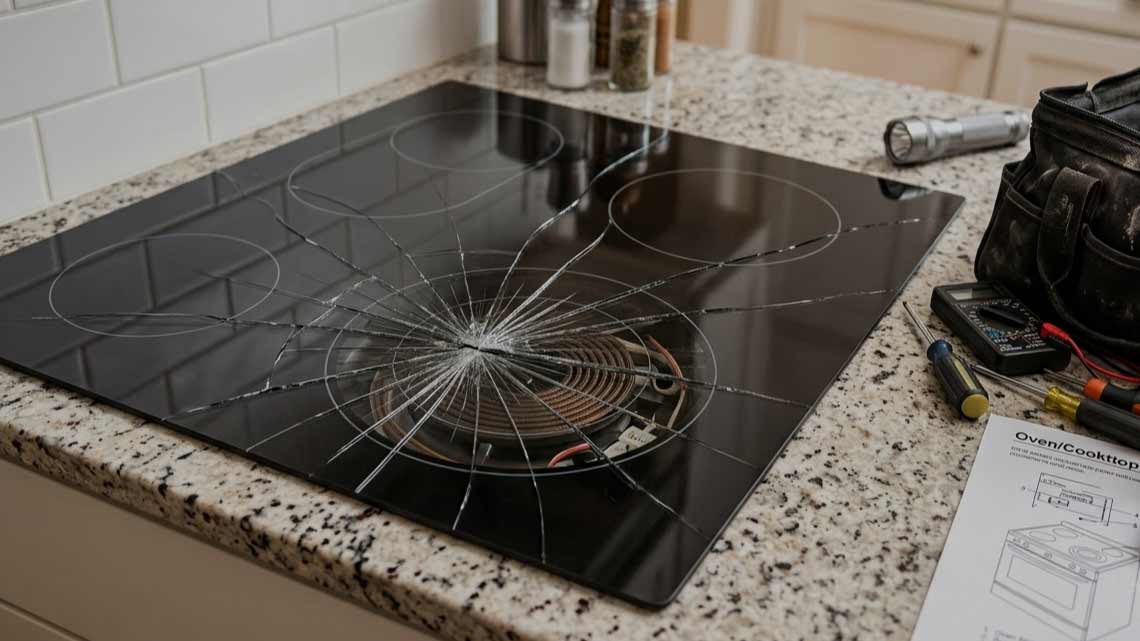
The call goes something like this: «My husband was doing dishes, set a heavy pan on the burner, and now there’s a crack across the whole surface. Can we still use it?» We’ve fielded that exact scenario maybe two hundred times over the years. Answer’s always the same — no, and here’s why.
Cracked glass on a cooktop looks like a cosmetic issue. It isn’t. The glass is what’s keeping liquid, crumbs, and everything else on your kitchen counter from finding its way down to the wiring and electrical modules that sit directly underneath. Break that seal and you’ve got a shock hazard, a potential fire, and an appliance that shouldn’t be running until it’s fixed. If yours cracked recently and you’re staring at it wondering what to do next, appliance repair Jacksonville FL technicians handle these all the time — glass replacement is usually a same-day or next-day job depending on the model.
Rest of this walks through why the glass cracks, when it’s an actual emergency versus just annoying, whether you can patch it (spoiler: nope), and how the actual fix goes.
Schedule your appliance repair today!
Why Glass Cooktops Crack
Not all cracks come from someone dropping something. Four main causes we run into.
- Impact — the obvious one. Cast iron is the biggest culprit here. A ten-inch skillet dropped even six inches onto a glass burner will crack it more often than not. Setting a pot down carelessly counts too, especially near the edge of a heated zone. The center of the burner is stronger than the edges where the glass transitions to unheated area.
- Thermal shock. This one catches people off guard. You’ve got a burner on high, boiling water for pasta. You reach into the fridge for a cold Pyrex dish, set it on an unheated part of the cooktop that’s still hot from residual heat, or — worse — spill cold water across a section that’s been at 500°F for twenty minutes. Fast temperature change on ceramic glass creates internal stress. It cracks. No impact, no visible warning. Just a snap sound and there’s a line across the surface.
- Standing on it. People do this. Kid climbs up to reach a cabinet. Someone stands on the range to change a lightbulb over the sink. The glass isn’t rated for that kind of point-load. One session on top of the cooktop and you’ve got hairline stress fractures that don’t show up until later, then propagate into visible cracks weeks or months down the road.
- Heavy pressure cookers. Modern electric pressure cookers weigh 15-30 pounds. Old-school stovetop pressure cookers can weigh even more when full. Manufacturers spec weight limits for glass surfaces (usually somewhere around 25-50 pounds including contents), and repeated use of anything close to that limit eventually finds a stress point. Same story with canning pots that homeowners use for tomato season every August.
- There’s a fifth cause worth mentioning: manufacturing defect. Rare, but a glass panel with a hidden flaw sometimes cracks during the first months of use for no apparent reason. If your cooktop is under warranty and cracked without impact or thermal shock you can identify, worth checking with the manufacturer before paying for repair yourself.
Is It Actually Dangerous
Depends what the crack looks like.
- Surface hairline that doesn’t go through the glass — cosmetic problem for now. You’re not going to shock yourself finishing the pasta you started. But these always spread. Every heat cycle stresses the glass a little more, and what’s superficial today becomes through-crack next week.
- Crack that goes all the way through — that’s where things change. Even hairline through-cracks let liquid down to what’s underneath. On radiant electric cooktops, that’s the heating element and wiring for the whole burner. On induction, it’s the copper coil, the temperature sensor, and the IGBT power module that switches current at high frequency. Getting water onto any of that risks a short, a tripped breaker, or in worst cases an electrical fire. Stop using it.
- Multiple cracks or spider-web pattern — game over on that unit until it’s fixed. Some cooktops (Bosch, higher-end Samsung, most premium built-ins) have detection sensors that disable the whole cooktop when they see this level of damage. Others just keep running as if nothing happened, which is actually more dangerous.
Run a fingernail across the crack. If your nail catches, the crack goes through. Don’t cook on it.
Can You Repair the Crack Instead of Replacing the Glass
Short answer: no, and please don’t waste money on the kits.
Every year or two somebody markets a «glass cooktop repair epoxy» or a «ceramic crack sealer.» We’ve seen customers try them. Doesn’t work. Ceramic glass has to survive temperatures above 500°F on every use, and no available consumer-grade repair material handles those temperatures. Epoxies char and off-gas. Silicones break down. Anything you can buy at a hardware store will fail within a few cooking sessions.
Beyond that, patching the surface doesn’t fix what actually broke. The crack is a structural failure in the glass itself. It’s going to spread regardless of what you put on top. And the seal against liquid is gone the moment the crack forms — no consumer product restores that.
Real fix is replacing the glass panel entirely, matched to your specific model.
What the Repair Involves
Standard glass cooktop replacement follows a specific sequence.
- Power at the breaker off.
- Cooktop lifts out of the countertop opening (built-ins) or the top surface of the range comes off (range/oven combos).
- Wiring disconnects from the heating elements or induction coils underneath.
- Old glass panel comes out. Replacement glass gets set in, wiring reconnects, everything tests for continuity, and the cooktop reassembles.
Actual labor is maybe an hour, hour and a half depending on the model. What eats the timeline is parts sourcing. Glass panels are model-specific — Whirlpool won’t fit GE, KitchenAid won’t fit Frigidaire, and even within one brand different generations use different mounting dimensions. Mainstream brands often have glass in stock or available next-day. Bosch, Thermador, Wolf, Viking, Miele frequently need a week or more.
That’s usually the biggest variable customers ask about. When’s this going to be fixed? Depends less on us than on the part warehouse.
What It Costs
Number that matters most: the glass panel itself. Widely variable by brand.
- For mainstream brands — Whirlpool, GE, Frigidaire, Kenmore, Maytag, Amana, KitchenAid, Jenn-Air — most complete replacements land between $200 and $500 with parts and labor. Nothing exotic about the pricing.
- Premium brands push considerably higher. Bosch, Thermador, Wolf, Viking, Miele glass panels aren’t just marked up — they’re genuinely more expensive to manufacture and less commonly stocked in North American warehouses. Total repair on premium brands frequently pushes past $500 and can hit $800-$1000 on some models.
A high-rated appliance repair company will pull the exact part number from your model plate, quote the actual replacement glass cost, and tell you the full price up front. Don’t take pricing over the phone before someone knows the specific model — the range is too wide across brands.
When to Replace the Whole Cooktop Instead
Sometimes the repair math doesn’t work. Situations we tell customers to consider full replacement:
- Cooktop’s 15+ years old. Even if the glass replaces fine, everything else is aging — heating elements, sensors, control board. Money spent on glass for a cooktop with three years of life left doesn’t recover its cost.
- Impact damage that involved more than just glass. Sometimes the drop that cracked the cooktop also broke a burner element or dented a heating coil underneath. Repairs stack.
- Glass part is discontinued. Older models sometimes lose parts availability entirely. Used parts pulled from scrapped units exist but timelines get long.
- Cost of glass alone exceeds half the price of a new comparable cooktop. Happens more on premium brands than mainstream ones.
Our techs will run this math with you on-site once they know the exact model. Nobody wins pushing a $600 repair on a cooktop that costs $800 new.
How a Service Visit Runs
When our Jacksonville appliance repair team gets called for a cracked cooktop, first thing we ask for is the make, model, and a photo of the damage. That lets us verify what glass part we need and whether it’s stocked before we schedule. On arrival, we confirm the damage, cross-check the model plate against the parts catalog, quote the flat repair price, and if approved, get the glass swapped in and tested. Brands we handle: Whirlpool, GE, KitchenAid, Frigidaire, Samsung, LG, Maytag, Kenmore, Jenn-Air, Amana, Bosch, Thermador, Wolf, Viking, Miele.
Name: Appliance Repair Jax
Adress: 164 Johns Glen Dr, Jacksonville, FL 32259
Phone: (904) 200-4110
Website: https://appliancerepairjax.com/
Conclusion
A cracked cooktop isn’t the end of the appliance — the glass is a replaceable part on almost every brand. What matters is not using it while cracked, since through-cracks let water down to electrical components that shouldn’t ever get wet. Replacement is usually a single visit once the correct glass is in hand. When yours needs handling, Appliance Repair Jax covers cracked cooktop repair across Jacksonville for every major brand — same-day service most days when you call before noon.
More Articles on Stove & Oven Repair
- Oven Making a Loud Noise When It Cycles? Causes & Fixes
- Oven Showing an Error Code? What It Means and How to Fix It
- Oven Smells Like Burning or Smoking? What’s Causing It
- Self-Cleaning Oven Not Working? Common Problems and How to Fix Them
- Oven Won’t Turn On at All? Power & Control Issues Explained
- Induction Cooktop Not Working? Troubleshooting Steps That Help
- Electric Cooktop or Glass-Top Burner Not Working: What to Do
- Stove Burner Not Working? Electric Troubleshooting Guide
- Oven Not Heating Up? 8 Common Causes & How to Fix Them
