


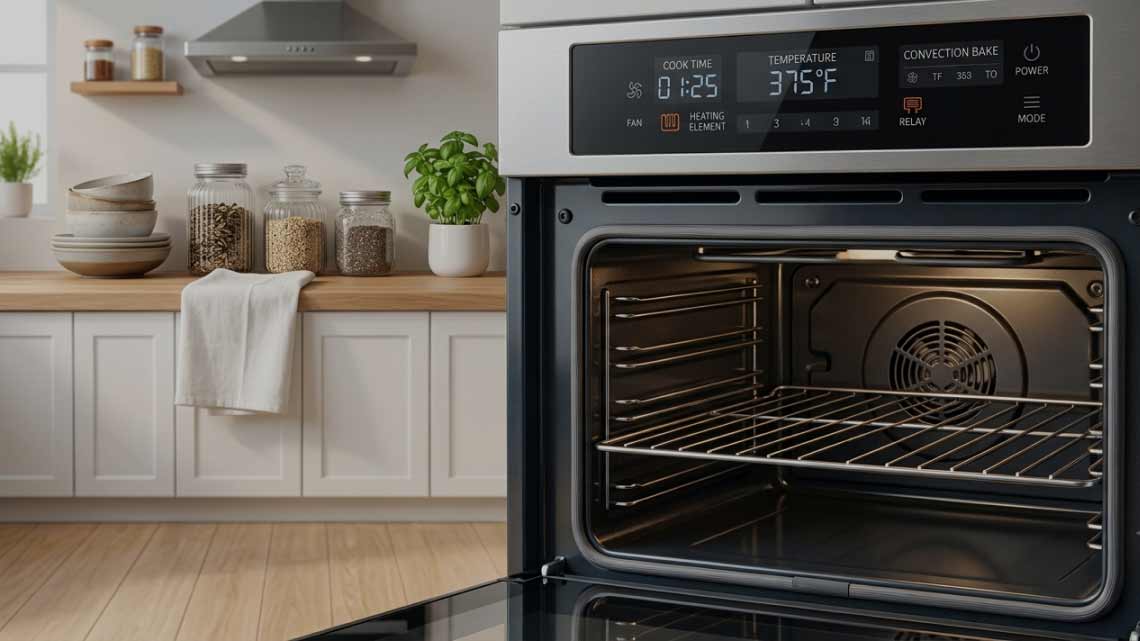
Oven noise gets a lot of confused homeowners because there’s actually a handful of things inside an oven that make sound, and each one sounds distinct. Fans hum and grind. Relays click. Metal pops as it heats and cools. Transformers buzz when they fail. Getting the diagnosis right starts with matching what you’re hearing to which part is failing. If yours is loud and you’d rather have someone come out and pin it down, appliance repair Jacksonville FL techs handle noisy ovens on same-day service.
Schedule your appliance repair today!
What’s Actually Making Noise in There
There’s not that many moving or noise-producing parts inside a modern oven. The list:
- Cooling fan behind or below the oven. Runs any time the cavity is hot to keep the control board from cooking itself.
- Convection fan inside the cavity. Only on convection models, runs during convection cooking and circulates hot air.
- Relays on the control board. Cycle power to the heating elements on and off. Every «on» and «off» is a click.
- Small transformer or capacitor circuits on the control board. Occasionally hum or buzz, especially when failing.
- Steel cavity walls. Expand as they heat and contract as they cool. Metal doing that makes popping sounds.
- Door hinges and door mechanism. Creak, thunk, or fail to hold the door position.
That’s it. Any noise from your oven traces back to one of those six sources. Match the sound to the source, and you know the general repair.
1. Cooling Fan Getting Louder
This is what I heard in our kitchen last night. Cooling fan behind or under the oven runs whenever the appliance is at temperature — the control board and touch panel are inside a hot appliance and need active cooling to survive their design lifespan. Fan bearings are the wear item. Cycles hot, cycles cool, thousands of times over years, and eventually the bearing surfaces roughen up. That’s when you start hearing them.
From first hum to seized takes anywhere from a few weeks to six months depending on how heavily the oven gets used. Not fixed by lubrication (bearings on modern fan motors are sealed and not user-serviceable). Only real fix is motor replacement.
One thing worth flagging: if the cooling fan seizes completely and the oven keeps running, the control board can overheat and die. That turns a $150 fan repair into a $400 board-plus-fan repair. So when it starts grinding, don’t put it off.
The cooling fan also runs after cooking, sometimes for ten to fifteen minutes while the cavity cools. That’s normal behavior even for a healthy fan.
2. Convection Fan Rattling Inside the Cavity
Different fan, different location, different symptoms. Convection fan sits inside the oven cavity — small paddle that spins to circulate hot air during convection modes. When something goes wrong with it, the noise comes from inside the oven itself rather than from the back.
Two common failures:
- Bearings wear out (same as cooling fan), producing grinding or squealing from inside the cavity.
- Or the fan blade works loose from the motor shaft and starts wobbling, which sounds more like a rapid rattling or ticking that speeds up when the fan spins faster.
Both need service. Neither gets better on its own.
Occasionally people bring us calls where the convection fan noise turns out to be a piece of foil or debris hitting the fan blade. Worth checking that before calling — turn off the oven, let it cool, look inside the fan housing (behind the back cavity panel on most models, sometimes accessible with just a screwdriver). If nothing’s in there, it’s the motor.
3. Clicking That Syncs with the Elements
Relays on the control board doing exactly what they’re supposed to. When the oven hits its temperature setpoint, the board opens the relay and cuts power to the heating element — click. Temperature drops a couple degrees, board closes the relay again — click. Ten or fifteen cycles during a long roast is completely normal. Where clicking becomes a problem is when it happens without cooking, or when it becomes constant and rapid instead of periodic.
- Clicking when the oven is off, breaker on, no cooking activity — that’s a stuck or failing relay.
- What to do: Kill the breaker until it’s diagnosed. This is one of the most common repair calls we see and it’s a real issue, not something to shrug off.
- Rapid clicking (every few seconds instead of once every couple of minutes) usually means the temperature sensor has drifted. The board sees the temperature reading swinging around, and cycles the element frantically trying to compensate.
- Fix: Sensor replacement solves it.
4. Buzzing and Humming Noises
Three separate things can produce a buzz:
- Failing relay — instead of a clean click, the contacts try to make and break and buzz in the process. Sometimes faint, sometimes loud. Usually happens when the oven should be actively heating. If you narrow the buzz to the control panel area, it’s a relay.
- Transformer failure — the small step-down transformer on the control board can develop a low hum as it fails. Sounds different from a relay buzz — more consistent, lower pitch, from further back in the appliance.
- Loose part vibrating — a screw came loose, a sheet-metal panel is resonating at a certain frequency, or the fan cage got bent and the blade grazes it once per rotation. This kind of buzz often changes if you gently press on the oven housing, and it’s the cheapest of the three to fix.
Distinguishing which one you have takes a tech with a stethoscope-style listening probe. That’s genuinely how we localize buzzing during service calls — trace the sound to its origin, then test the associated component.
5. Popping and Ticking — Almost Always Fine
Metal cavity walls expand as they heat and contract as they cool. Steel that goes from 70°F room temperature to 400°F is a physical change big enough to shift panels against each other slightly. That’s your pop. Happens more during preheating (rapid expansion) and after shutoff (rapid contraction). Not a repair issue on 99% of ovens.
Wall ovens sometimes pop louder because the cavity walls are larger. Some brands are noisier than others just from panel design — Wolf M-series has a well-known reputation for being audibly warmer during heating cycles than most other brands, and their manuals actually mention it.
Exception worth mentioning: if a pop sounds like an actual sharp crack rather than a soft thump, especially near the door glass, inspect the glass for hairline cracks. Rare but not unheard of for oven door glass to develop stress fractures. If you find a crack, stop using the oven and get it replaced — we covered that in more depth in our cracked cooktop guide.
6. Grinding or Squealing
Same territory as fan bearings. Squealing is early stage, grinding is later stage, seized is the end state. If either sound starts on your oven, the clock is running.
I mentioned earlier that a seized fan can cascade into control board damage. A high-rated appliance repair company can identify which fan is grinding and quote the specific replacement — usually a same-visit repair when the model is common enough for us to stock the motor.
7. Door Sounds
Hinge creak on opening or closing — worn hinge springs. Not urgent but worth fixing since a poorly-hinged door doesn’t seal properly and heat leaks out during cooking, which makes the oven run longer and stress everything else.
- Door slamming shut on its own or refusing to stay open at intermediate positions — springs have lost tension. Hinge replacement.
- Door won’t close all the way — could be worn gasket, misaligned hinge, or bent door frame. Different fixes for each.
How a Service Call Runs
When our Jacksonville appliance repair team gets a noisy-oven call, we ask two questions before dispatching: describe the noise (grinding, clicking, buzzing, popping) and when it happens (during heating, when off, only convection mode). Those two data points narrow the diagnosis to two or three possible parts before we’re on-site. Rest of the visit is confirmation and repair. Fan motors, relays, control boards, hinge assemblies stay stocked on the truck. Brands: Whirlpool, GE, KitchenAid, Frigidaire, Samsung, Maytag, Kenmore, LG, Bosch, Thermador, Wolf, Viking, Miele.
Name: Appliance Repair Jax
Adress: 164 Johns Glen Dr, Jacksonville, FL 32259
Phone: (904) 200-4110
Website: https://appliancerepairjax.com/
Conclusion
Most oven noise falls into two buckets: totally normal (thermal expansion, cooling fan hum, occasional relay click) or a component starting to fail (grinding bearings, buzzing relays, clicking when off). Getting a diagnosis before the failing part takes something else with it is what keeps a $150 repair from becoming a $400 repair. When your oven needs handling, Appliance Repair Jax covers noisy-oven diagnosis and repair across Jacksonville — every major brand, same-day service most days when you catch us before noon.
More Articles on Stove & Oven Repair
- Cracked Glass Cooktop: Is It Safe to Use & How It’s Fixed
- Oven Showing an Error Code? What It Means and How to Fix It
- Oven Smells Like Burning or Smoking? What’s Causing It
- Self-Cleaning Oven Not Working? Common Problems and How to Fix Them
- Oven Won’t Turn On at All? Power & Control Issues Explained
- Induction Cooktop Not Working? Troubleshooting Steps That Help
- Electric Cooktop or Glass-Top Burner Not Working: What to Do
- Stove Burner Not Working? Electric Troubleshooting Guide
- Oven Not Heating Up? 8 Common Causes & How to Fix Them
